Heavy metal exposure is not a fringe concern. Lead in old plumbing and paint, cadmium in cigarette smoke and some foods, arsenic in groundwater and rice, mercury in certain fish — low-level exposure is part of modern life, and the gut is the first line of defense against most of it. Long before a metal ever reaches the bloodstream, it has to cross the intestinal lining. That fact has put a specific mineral, zeolite, at the center of a growing (and often overstated) conversation about “detox.”
This article looks at what the peer-reviewed literature actually says about zeolite — specifically the natural zeolite clinoptilolite — and where the gut health connection is real versus where it’s marketing.
What Zeolite Actually Is
Zeolites are crystalline aluminosilicate minerals with a honeycomb-like, microporous structure. Clinoptilolite, the form used in nutrition and medicine, has a cage-like architecture riddled with negatively charged channels that hold loosely bound ions — mainly calcium, potassium, sodium, and magnesium. Because those channels are open, other positively charged ions circulating through the gut, including toxic metals like lead and cadmium, can swap places with the zeolite’s native ions. This is called ion exchange, and it works alongside simple physical adsorption, where the porous structure traps molecules within its cage.
Critically, clinoptilolite is not absorbed across the intestinal wall. It passes through the gastrointestinal tract and is excreted largely intact, which is the basis for its proposed safety profile as an oral supplement.
What the Evidence Shows on Heavy Metal Binding
The strongest human evidence comes from a 2021 randomized, double-blind, placebo-controlled trial published in Scientific Reports. Researchers gave 42 healthy adults a stable lead isotope (²⁰⁴Pb) in water, either alone or together with purified clinoptilolite tuff (G-PUR). Using mass spectrometry to track the isotope, they found that clinoptilolite reduced enteral (gut) absorption of lead by roughly 86–90% compared to placebo — a substantial and statistically significant effect (Samekova et al., 2021).
A separate line of animal research adds mechanistic support. A 2023 study in the journal Biology fed rats activated clinoptilolite for twelve weeks and tracked concentrations of aluminum, arsenic, cadmium, lead, nickel, cobalt, and strontium across blood, bone, liver, kidney, and intestinal tissue using ICP-MS. The zeolite-fed rats showed reduced accumulation of several of these metals in kidney, bone, and intestinal tissue, with a transient rise in serum levels — consistent with metals being mobilized out of storage tissue before elimination (Dolanc et al., 2023).
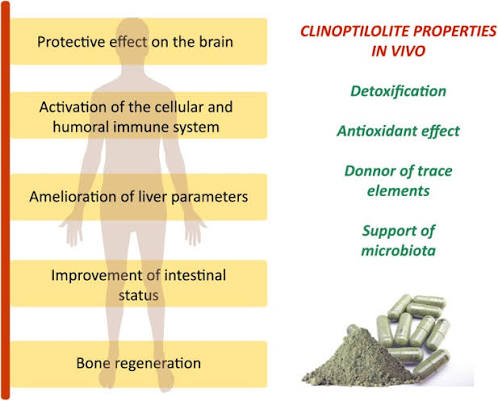
A 2024 review in the Journal of Functional Biomaterials compiled findings across multiple controlled clinical studies of a standardized clinoptilolite product (PMA-zeolite), including a 12-week trial in which supplemented participants showed significant reductions in blood arsenic, and shorter trials showing reductions in mercury and cadmium in individuals who started with elevated levels (Bulog et al., 2024).
The honest caveat: these effects are more pronounced in people with elevated baseline metal exposure. There’s little evidence that healthy individuals with normal metal levels see meaningful additional benefit, and none of this research supports zeolite as a treatment for acute heavy metal poisoning, which requires medical management, not a supplement.
The Gut Barrier Connection
Separately from metal binding, zeolite has been studied for its effect on intestinal barrier integrity — the tight junctions between gut cells that, when compromised, allow bacterial fragments and inflammatory triggers to leak into circulation (often referred to as increased intestinal permeability).
A randomized, double-blind, placebo-controlled trial published in the Journal of the International Society of Sports Nutrition gave 52 endurance-trained adults 1.85 g of zeolite daily for 12 weeks. The zeolite group showed a significant reduction in stool zonulin — a protein that regulates the opening of intestinal tight junctions — alongside favorable shifts in inflammatory markers, compared to placebo (Lamprecht et al., 2015). The 2024 Journal of Functional Biomaterials review also cites controlled trials in which a purified clinoptilolite product reduced abdominal pain and improved stool consistency in patients with diarrhea-predominant IBS, with a meaningfully higher proportion of participants reporting relief versus placebo (Bulog et al., 2024).
This is a genuinely interesting line of research, but it remains a relatively small evidence base concentrated in a few research groups, mostly using specific proprietary formulations — which matters when comparing it to the wide range of zeolite products sold as generic supplements.
What This Doesn’t Mean
- Zeolite is not a cure or a detox in the wellness-industry sense. It doesn’t “flush toxins” broadly; the evidence is specific to certain metals, under certain exposure conditions, with certain formulations.
- Product quality varies enormously. Unrefined or mined zeolite can itself be contaminated with heavy metals, which defeats the purpose. The clinical studies above used purified, characterized materials (like G-PUR or PMA-zeolite) — not necessarily what’s on a generic supplement shelf.
- It can interfere with mineral status and medication absorption if taken too close to meals or prescription drugs, since ion exchange doesn’t distinguish toxic metals from essential ones like calcium or magnesium as precisely as marketing suggests.
- It is not a substitute for identifying and removing the exposure source, or for medical evaluation if heavy metal toxicity is suspected.
Where This Fits Into a Gut Health Strategy
Heavy metal exposure and intestinal barrier integrity don’t exist in isolation — they interact with overall gut and mineral status, which is why this kind of intervention should be considered as part of a broader clinical picture rather than a standalone fix. If you’re already working through gut health support, zeolite is one of several tools worth discussing with a clinician, alongside trace mineral status — zinc, for instance, plays its own foundational role in maintaining the same intestinal barrier that zeolite research targets.
As with most supplements marketed around “detox,” the real question isn’t whether zeolite can do something under laboratory conditions — it’s whether it’s the right, well-sourced, correctly dosed tool for your specific situation. That’s a conversation worth having with a professional who can review your history and actual exposure risk, not a label.
Bibliography
- Samekova, K., Firbas, C., Irrgeher, J., Opper, C., Prohaska, T., Retzmann, A., Tschegg, C., Meisslitzer, C., Tchaikovsky, A., Gouya, G., Freissmuth, M., & Wolzt, M. (2021). Concomitant oral intake of purified clinoptilolite tuff (G-PUR) reduces enteral lead uptake in healthy humans. Scientific Reports, 11, 14796. https://doi.org/10.1038/s41598-021-94245-x
- Dolanc, I., Ferhatović Hamzić, L., Orct, T., Micek, V., Šunić, I., Jonjić, A., Jurasović, J., Missoni, S., Čoklo, M., & Kraljević Pavelić, S. (2023). The Impact of Long-Term Clinoptilolite Administration on the Concentration Profile of Metals in Rodent Organisms. Biology, 12(2), 193. https://doi.org/10.3390/biology12020193
- Lamprecht, M., Bogner, S., Steinbauer, K., Schuetz, B., Greilberger, J. F., Leber, B., Wagner, B., Zinser, E., Petek, T., Wallner-Liebmann, S., Oberwinkler, T., Bachl, N., & Schippinger, G. (2015). Effects of zeolite supplementation on parameters of intestinal barrier integrity, inflammation, redox biology and performance in aerobically trained subjects. Journal of the International Society of Sports Nutrition, 12, 40. https://doi.org/10.1186/s12970-015-0101-z
- Bulog, A., Pavelić, K., Šutić, I., & Kraljević Pavelić, S. (2024). PMA-Zeolite: Chemistry and Diverse Medical Applications. Journal of Functional Biomaterials, 15(10), 296. https://doi.org/10.3390/jfb15100296
- Mastinu, A., Kumar, A., Maccarinelli, G., Bonini, S. A., Premoli, M., Aria, F., Gianoncelli, A., & Memo, M. (2019). Zeolite Clinoptilolite: Therapeutic Virtues of an Ancient Mineral. Molecules, 24(8), 1517. https://doi.org/10.3390/molecules24081517