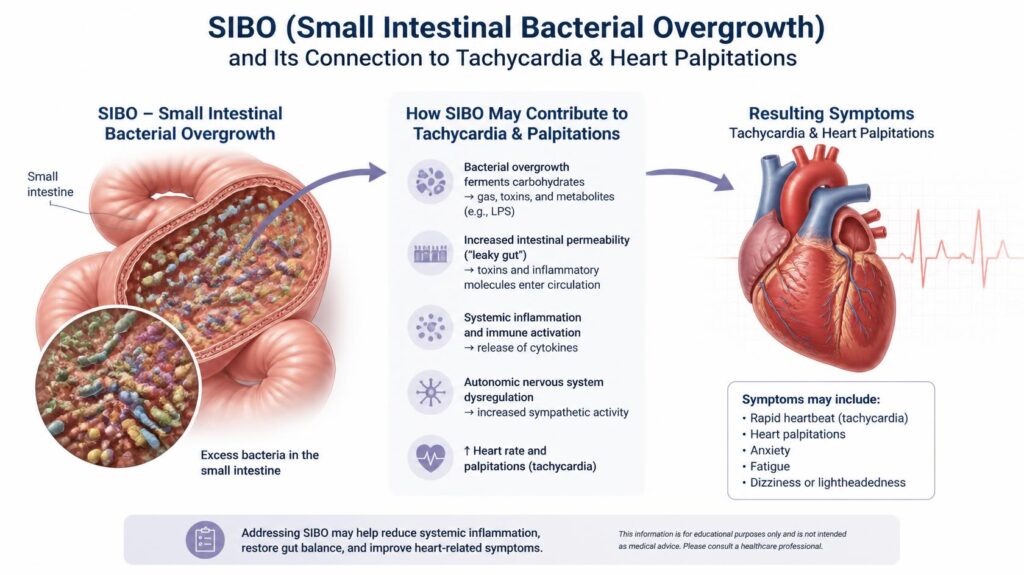
Heart palpitations and a racing pulse after eating are usually the first thing that sends someone to a cardiologist — understandably so. But for a subset of patients whose cardiac workup comes back completely normal, the real driver may not be the heart at all. It may be the gut. Specifically, Small Intestinal Bacterial Overgrowth (SIBO).
This isn’t a fringe idea. A growing body of research on the gut-brain-heart axis is starting to explain why digestive dysfunction can produce sensations that feel unmistakably cardiac.
The Vagus Nerve: The Direct Line Between Gut and Heart
The vagus nerve is the longest nerve in the body, running from the brainstem down through the chest and into the abdomen, and it carries signals in both directions between the gut, the brain, and the heart. It’s the same nerve responsible for slowing the heart rate at rest — so when its signaling gets disrupted at the gut end, the heart end can misfire too.
This isn’t just theoretical. Research on autonomic function in SIBO patients has directly documented this link: investigators found that <cite index=”30-1″>vagal dysfunction was associated with slowed gastric emptying and SIBO</cite>, and correlated this with elevated inflammatory markers like IL-6. In other words, the same nerve dysfunction that slows digestion enough to contribute to bacterial overgrowth is also the nerve responsible for regulating heart rhythm.
Roemheld Syndrome: When Gut Pressure Mimics a Cardiac Event
There’s actually a named clinical entity for this exact phenomenon: Roemheld syndrome, also called gastrocardiac syndrome. A recent review describes it as <cite index=”35-1″>a gut–brain–heart triad, interconnected by the vagus nerve</cite>, where gas and bloating in the intestines push upward against the diaphragm, mechanically stimulating the vagus nerve and altering heart rate — producing a sensation that feels exactly like a cardiac event, typically after meals.
The review also notes something clinically important: chronic anxiety and low vagal tone can become a two-way street with digestive symptoms, where sympathetic overactivation disrupts gut motility, and gut distress in turn triggers more sympathetic activation — a loop that can make symptoms feel progressively worse over time.
Histamine: The Other Mechanism
SIBO doesn’t just affect the vagus nerve mechanically — certain bacterial strains involved in SIBO produce excess histamine as a byproduct of fermentation. In people who are already prone to histamine sensitivity, this can directly trigger palpitations, independent of any vagal or mechanical effect. One clinical summary notes that <cite index=”28-1″>certain types of SIBO can increase histamine production, and elevated histamine levels in susceptible individuals are known to cause palpitations</cite>.
This histamine pathway is worth flagging separately from the vagal one because it responds to different interventions — dietary histamine reduction and addressing the bacterial overgrowth itself, rather than vagal tone work alone.
What the Pattern Often Looks Like
Clinically, gut-related palpitations tend to follow a recognizable pattern rather than occurring randomly. According to one gut-health clinical resource, patients often notice <cite index=”32-1″>palpitations that cluster 30–90 minutes after meals</cite>, along with skipped or fluttering beats tied to bloating, gas, or reflux, and symptoms that flare after fermented foods, leftovers, or aged cheese — all foods that are either high in histamine or particularly fermentable by SIBO-associated bacteria.
This meal-timing pattern is one of the more useful clues in distinguishing gut-driven palpitations from a primary cardiac arrhythmia, though it should never replace an actual cardiac workup.
The Overlap With POTS
There’s also a documented overlap between gut dysfunction and Postural Orthostatic Tachycardia Syndrome (POTS), a condition defined by an abnormal heart rate increase on standing. POTS shares several features with SIBO-related autonomic dysfunction, including a strong female predominance and a symptom profile dominated by fatigue and palpitations. While POTS is a distinct diagnosis with its own autoimmune and hemodynamic mechanisms, the overlap in autonomic nervous system involvement is one more piece of evidence that gut and cardiac symptoms are far more intertwined than they’re usually treated.
What This Means in Practice
None of this is a reason to skip a cardiac evaluation — palpitations always warrant ruling out a primary heart condition first, especially if they’re new, severe, or accompanied by chest pain, fainting, or shortness of breath. But once cardiac causes are ruled out and the workup keeps coming back clean, it’s reasonable to ask whether the gut is driving the symptom.
Practical signs that point toward a gut-driven cause rather than a primary cardiac one:
- Palpitations reliably follow meals, especially large or fermentable ones
- Symptoms cluster with bloating, gas, or reflux
- A cardiac workup (ECG, Holter monitor, echocardiogram) has come back normal
- There’s a known or suspected history of SIBO, dysbiosis, or IBS
If these patterns sound familiar, getting tested for SIBO and taking a broader look at gut health— rather than another round of cardiac testing — may be the more useful next step. Book a virtual consultation with Dr. Schirippa to find out.
This article is for informational purposes only and does not replace a medical evaluation. New, severe, or persistent heart palpitations should always be assessed by a physician to rule out a primary cardiac cause before considering gut-related explanations.
References
- THE BRAIN-GUT CONNECTION. Dr. Nicholas L. DePace, M.D., F.A.C.C. Franklin Cardiovascular Associates.
- Understanding the Gut-Heart Axis in Roemheld Syndrome: Mechanisms and Clinical Insights. Encyclopedia (MDPI), 2024.
- Can SIBO Cause Heart Palpitations? Biology Insights, 2025.
- Gut Health and the Heart: Can Digestive Issues Cause Heart Palpitations? Tiny Health.
- Interplay Among Gut Microbiota-Derived TMAO, Autonomic Nervous System Dysfunction, and Heart Failure Progression. PMC.
- Postural Orthostatic Tachycardia Syndrome Is Associated With Elevated G-Protein Coupled Receptor Autoantibodies. Journal of the American Heart Association.