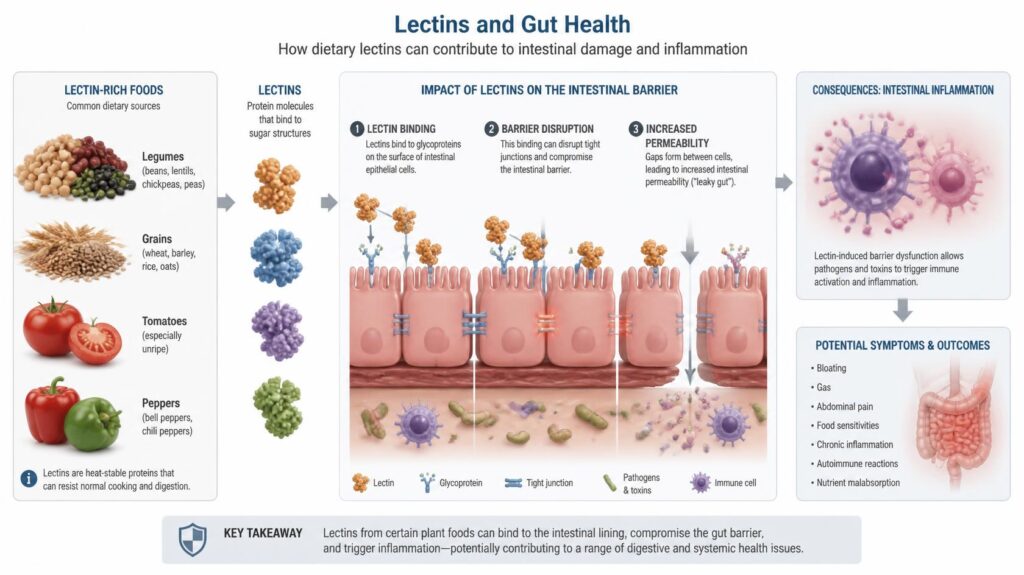
Lectins have become one of the most talked-about — and most misunderstood — topics in gut health. Some corners of the wellness world treat them as a universal toxin to be avoided at all costs; others dismiss the concern entirely. The real picture, as usual, sits in between: lectins are a well-documented contributor to intestinal permeability, but the degree of risk depends heavily on the type of lectin, the amount consumed, and how the food is prepared.
What Lectins Actually Are
Lectins are carbohydrate-binding proteins found throughout the plant kingdom, most concentrated in legumes, whole grains, nightshades, and certain seeds and nuts. Plants produce them largely as a natural defense mechanism against insects, fungi, and predators. In humans, lectins are notable for one specific property: they are largely resistant to digestion, meaning a meaningful fraction can survive the trip through the stomach and reach the small intestine still structurally intact.
That resistance to breakdown is precisely what makes them relevant to gut health — a protein that survives digestion is a protein that stays in physical contact with the intestinal lining for longer than most.
The Mechanism: How Lectins Contribute to Leaky Gut
“Leaky gut,” more precisely called increased intestinal permeability, describes a breakdown in the tight junctions — the protein structures that seal the space between intestinal epithelial cells and normally control exactly what is allowed to pass from the gut into the bloodstream. When those junctions loosen, larger molecules that shouldn’t cross the barrier — undigested food particles, bacterial fragments, toxins — begin to slip through.
Lectins are directly implicated in this process. Research on the topic describes it plainly: the binding of lectins to epithelial cells may cause inflammation, damage to the tight junctions, and leaky gut, which has been proposed as the gateway to autoimmunity. The same research traces the mechanism further, noting that lectins can interact directly with gut bacteria and trigger the release of endotoxins, compounding the permeability problem beyond the direct physical effect on the tight junctions themselves.
Wheat Germ Agglutinin: The Best-Studied Case
Among all dietary lectins, wheat germ agglutinin (WGA) — found concentrated in the germ layer of wheat — has the most direct experimental evidence behind it. Laboratory studies on human intestinal cell models found that WGA alters gastrointestinal epithelium integrity at micromolar concentrations, and at nanomolar concentrations stimulates pro-inflammatory cytokine synthesis in immune cells</cite>. In practical terms, this means WGA doesn’t just weaken the physical seal between gut cells — at even smaller doses, it can independently trigger an inflammatory immune response.
Older animal research adds a second layer to this picture. Feeding studies found that <cite index=”42-1″>WGA and related lectins acted as growth factors for the gut, interfering with its normal metabolism and function, with WGA producing the most pronounced hyperplastic and hypertrophic changes to the small bowel</cite> — meaning the intestinal tissue itself was forced into abnormal growth patterns simply from chronic lectin exposure.
What Happens When the Gut Barrier Breaks Down
Once intestinal permeability increases, the consequences aren’t confined to the gut itself. Substances that leak across the barrier — bacterial endotoxins (particularly lipopolysaccharides, or LPS), incompletely digested proteins, and other microbial byproducts — enter systemic circulation and trigger an immune response well beyond the digestive tract.
This is where leaky gut connects to a much wider set of health concerns. It has been proposed as a contributing mechanism in:
- Autoimmune conditions — including rheumatoid arthritis and Hashimoto’s thyroiditis, where circulating antigens are thought to help drive the abnormal immune activation characteristic of these diseases
- Chronic systemic inflammation — driven largely by circulating LPS, which is one of the most potent triggers of the innate immune system
- Digestive disorders — including irritable bowel syndrome and inflammatory bowel disease, where barrier dysfunction and symptom severity tend to move together
- Metabolic and liver-related consequences — broader research on gut permeability has linked chronic endotoxemia to conditions ranging from metabolic dysfunction to liver disease, underscoring that the gut barrier’s integrity has effects far beyond digestion
Not All Lectins Are Equal — and Preparation Matters
This is the detail most lectin-avoidance content leaves out: lectin content and activity vary enormously by food and, more importantly, by preparation method. Raw or undercooked kidney beans are a well-documented case — they contain high concentrations of a lectin potent enough to cause acute gastrointestinal illness within hours if eaten improperly prepared. Proper soaking and thorough cooking deactivate the vast majority of lectin activity in legumes, which is precisely why virtually every traditional legume-based cuisine in the world involves long soaking and cooking times — a practice that predates any modern scientific understanding of the mechanism.
Grains present a more nuanced case. WGA in wheat is concentrated specifically in the germ, and dose matters considerably — research modeling realistic consumption found that <cite index=”44-1″>reaching toxic levels of WGA would require consuming more than a kilogram of uncooked pasta in a single meal</cite>, suggesting that occasional exposure through refined wheat products is a very different scenario from concentrated, chronic intake of whole-grain wheat germ.
Practical Takeaways
- Preparation is not optional. Soaking, sprouting, fermenting, and thorough cooking meaningfully reduce lectin activity in legumes and grains — these aren’t just culinary traditions, they’re functional detoxification steps.
- Dose and frequency matter more than total avoidance. For most people without an existing gut barrier issue, occasional lectin-containing foods prepared properly are unlikely to drive meaningful permeability changes.
- People with existing gut or autoimmune conditions may be more sensitive. If the intestinal barrier is already compromised, the same lectin exposure that a healthy gut tolerates without issue may provoke a stronger reaction. If that sounds like you, it’s worth asking about your specific situation.
- Canned legumes are a reasonable shortcut. Commercial canning processes use adequate heat to deactivate most problematic lectins, making canned beans and lentils a practical, lower-lectin option compared to poorly home-cooked versions.
The Bottom Line
The mechanistic case for lectins contributing to intestinal permeability is well supported by both cell-culture and animal research, and wheat germ agglutinin in particular has some of the clearest experimental data of any dietary lectin. That said, the evidence supports a nuanced position rather than blanket avoidance: preparation method, dose, and individual gut health status all meaningfully change the risk. For someone actively working to repair gut barrier function — including patients managing autoimmune conditions or chronic digestive symptoms — a temporary reduction in high-lectin foods, paired with proper preparation of the ones that remain in the diet, is a reasonable, evidence-informed strategy rather than a fad.
This article is for informational purposes only and does not replace a medical or nutritional evaluation. Anyone with a suspected autoimmune condition or persistent digestive symptoms should be assessed by a qualified healthcare professional before making significant dietary changes.