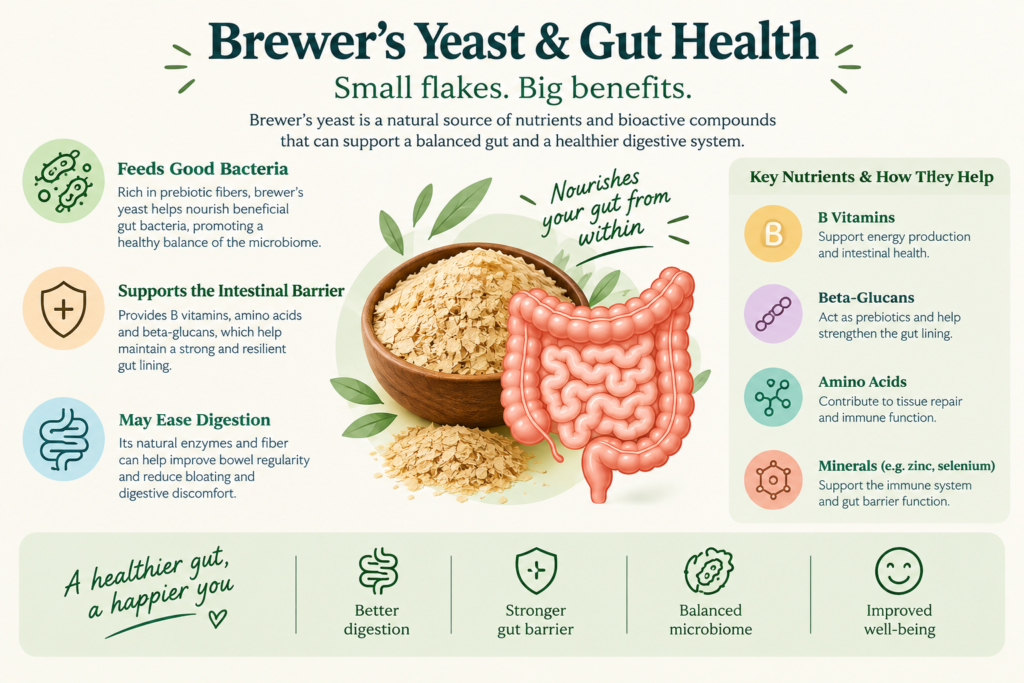
Saccharomyces cerevisiae is best known as the yeast behind bread, beer and wine. But one of its strains, Saccharomyces boulardii (also called S. cerevisiae var. boulardii), is used as a probiotic to support digestive health. It is one of the few probiotic yeasts with clinical evidence behind it. So what does the research actually show, and who should be careful?
Baker’s yeast is not the same as a probiotic yeast
Probiotic effects are strain-specific. The clinical trials discussed below were carried out with S. boulardii, and in the most rigorous meta-analysis on the topic the authors deliberately focused on one well-defined strain, S. boulardii CNCM I-745, so their findings could be applied directly to practice [1]. Results for one probiotic cannot be assumed for another [9]. In practice, eating bread or drinking beer is not a substitute for a tested probiotic supplement.
How probiotic yeast works in the gut
Unlike most bacterial probiotics, S. boulardii survives gastric acid and antibiotics [4]. Its effects also appear to be transient and independent of colonising the gut, which sets its mode of action apart from many bacterial probiotics [3]. Research, mostly in laboratory and animal models, points to several mechanisms:
- Neutralising toxins and pathogens. It secretes enzymes that act on bacterial toxins and can limit pathogen adhesion [3][4].
- Supporting the gut barrier. In experimental work it increases mucus production and tight-junction proteins such as ZO-1 and occludin [4][5]. If you are curious about barrier function in general, read our article on lectins and leaky gut.
- Calming inflammation. It modulates inflammatory signalling pathways such as NF-κB [3].
- Helping digestion. It boosts brush-border enzymes involved in digestion of sugars and nutrient uptake [6].
Keep in mind that many of these findings come from cells and animals. They explain how the yeast might work, not proof that it works in every person.
The best-supported benefit: antibiotic-associated diarrhoea
Antibiotics can upset the gut microbiota and cause diarrhoea. This is where the evidence for S. boulardii is strongest. A 2015 systematic review of randomised trials found that it reduced the risk of antibiotic-associated diarrhoea from 17.4% to 8.2% in adults and from 20.9% to 8.8% in children (read the meta-analysis) [1]. An earlier meta-analysis of 27 trials with 5,029 patients had also reported a significant protective effect [2]. In trials, the yeast was usually started together with the antibiotic and continued for a few days afterwards [2].
For Clostridioides difficile-associated diarrhoea the picture is more limited. The 2015 review found a significant reduction in children but not in adults [1].
Other uses: promising but less established
S. boulardii has also been studied in irritable bowel syndrome, inflammatory bowel disease and traveller’s diarrhoea, but the evidence is weaker than for antibiotic-associated diarrhoea. A new multicentre, placebo-controlled trial in IBS is now registered, which shows the question is still open [10]. A fibre-rich diet remains the foundation of a healthy microbiome, and prebiotics such as those described in our guide to inulin and gut health work alongside, not instead of, any probiotic.
Safety: who should avoid it
For healthy people, S. boulardii is generally well tolerated. But there is an important exception. Rare cases of fungaemia (yeast in the bloodstream) have been reported, mostly in critically ill or immunocompromised patients and in people with central venous catheters [7][8]. In 2017 the European Medicines Agency concluded that S. boulardii medicines should be contraindicated in these groups [8]. A review of published cases by the US CDC reached the same conclusion: these probiotics are not recommended for patients with indwelling catheters, or who are immunocompromised or critically ill [7] (read the CDC review). Anyone with a known yeast allergy should also avoid it.
Practical takeaways
- Choose a product that names the strain (for example S. boulardii CNCM I-745) and follow the label.
- If you are taking antibiotics, ask your doctor or pharmacist whether a probiotic yeast is appropriate.
- Do not use it if you are immunocompromised, critically ill or have a central venous catheter unless your specialist says so.
- Support it with a varied, fibre-rich diet.
Key takeaways
- The probiotic yeast studied in humans is S. boulardii, a strain of S. cerevisiae, not baker’s or brewer’s yeast in general.
- The strongest evidence is for preventing antibiotic-associated diarrhoea in adults and children.
- Evidence for IBS, IBD and barrier repair is still emerging, and much of it comes from lab and animal studies.
- It should be avoided in immunocompromised or critically ill patients and in people with central venous catheters.
This article is for general information and does not replace medical advice.
References
[1] Szajewska H, Kołodziej M. Systematic review with meta-analysis: Saccharomyces boulardii in the prevention of antibiotic-associated diarrhoea. Aliment Pharmacol Ther. 2015;42(7):793-801. doi:10.1111/apt.13344
[2] McFarland LV. Systematic review and meta-analysis of Saccharomyces boulardii in adult patients. World J Gastroenterol. 2010;16(18):2202-2222. https://www.wjgnet.com/1007-9327/full/v16/i18/2202.htm
[3] Saccharomyces boulardii: what makes it tick as successful probiotic? J Fungi. 2020;6(2):78. https://www.mdpi.com/2309-608X/6/2/78
[4] Saccharomyces boulardii as a probiotic yeast in food applications and its health properties: a review and future perspectives. Front Nutr. 2026. doi:10.3389/fnut.2026.1864466. PMID 42488210.
[5] Beneficial effects of Saccharomyces boulardii CNCM I-745 on clinical disorders associated with intestinal barrier disruption. Clin Exp Gastroenterol. 2019. https://pmc.ncbi.nlm.nih.gov/articles/PMC6375115/
[6] Moré MI, Vandenplas Y. Saccharomyces boulardii CNCM I-745 improves intestinal enzyme function: a trophic effects review. Clin Med Insights Gastroenterol. 2018. doi:10.1177/1179552217752679
[7] Fungemia and other fungal infections associated with use of Saccharomyces boulardii probiotic supplements. Emerg Infect Dis. 2021;27(8). https://wwwnc.cdc.gov/eid/article/27/8/21-0018_article
[8] European Medicines Agency, CMDh. Saccharomyces boulardii: scientific conclusions and grounds for variation of the product information (PSUSA/00009284/201702). https://www.ema.europa.eu/en/documents/psusa/saccharomyces-boulardii-cmdh-scientific-conclusions-and-grounds-variation-amendments-product-information-and-timetable-implementation-psusa00009284201702_en.pdf
[9] Regulatory oversight and safety of probiotic use. Emerg Infect Dis. 2010;16(11). https://wwwnc.cdc.gov/eid/article/16/11/10-0574_article
[10] ClinicalTrials.gov. Saccharomyces boulardii CNCM I-745 in irritable bowel syndrome (NCT07168434). https://clinicaltrials.gov/study/NCT07168434