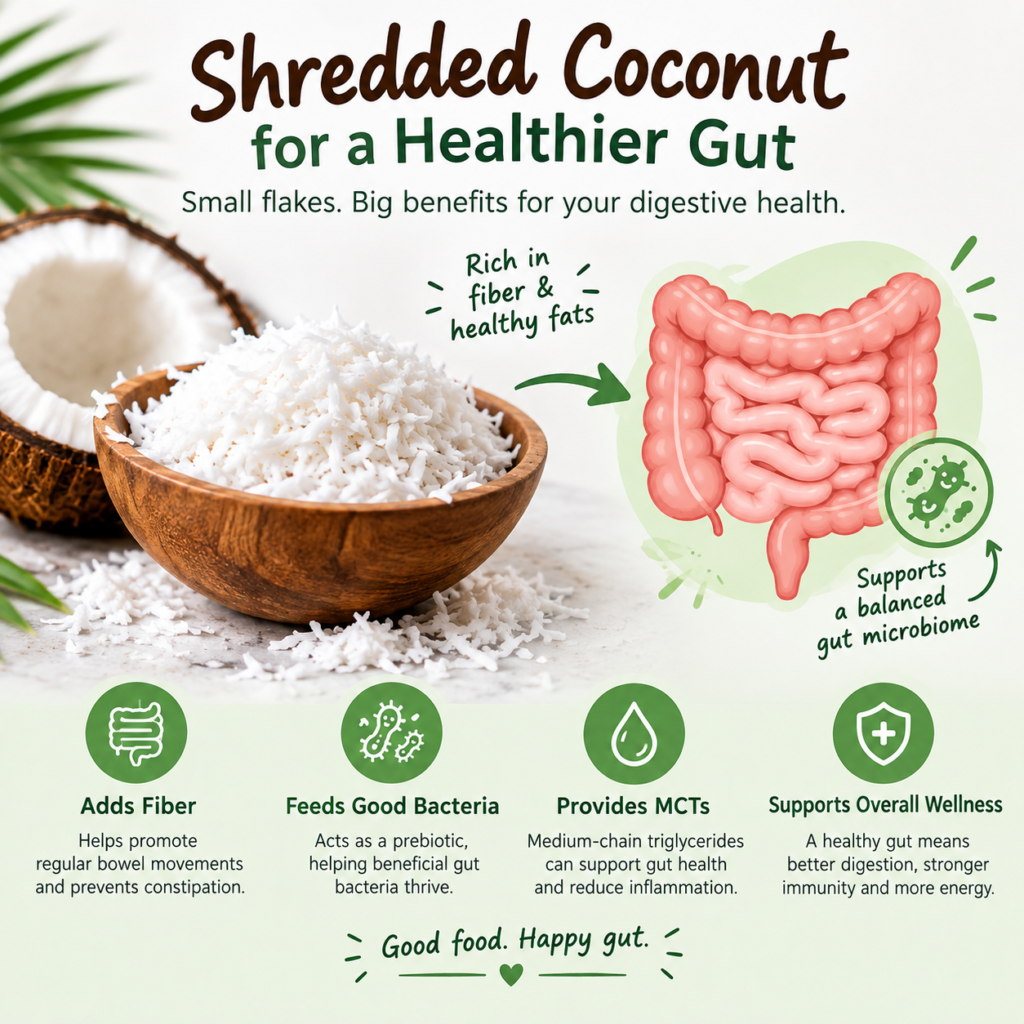
Coconut oil, coconut water, shredded coconut, coconut flour — few foods have been marketed as aggressively to the gut-health crowd as coconut, usually on the strength of two claims: that its “healthy fats” fight off bad bacteria, and that it soothes and heals the gut lining. Both claims have some real biochemistry behind them. Neither is as simple as the marketing suggests.
This article looks at what the actual research says about coconut’s fatty acids and the intestinal microbiome — including the parts that don’t fit neatly into a wellness headline.
What Makes Coconut Different: Medium-Chain Fatty Acids
About half of the fat in coconut oil is lauric acid, a 12-carbon medium-chain fatty acid (MCFA). Unlike the long-chain fats that make up most dietary fat, medium-chain fatty acids are absorbed and metabolized differently, and — more relevant here — they have a well-documented ability to disrupt the lipid membranes of certain microorganisms.
Inside the body, a portion of lauric acid is converted to monolaurin, a compound that appears to physically destabilize the outer membrane of susceptible bacteria, fungi, and some enveloped viruses. Laboratory work has repeatedly shown this to be a real, mechanistic effect, not just a marketing claim: in one in vitro study, lauric acid was the most potent of eleven fatty acids tested against multiple strains of Clostridioides difficile, a bacterium responsible for severe antibiotic-associated diarrhea, and lauric acid pretreatment also reduced infection symptoms in a mouse model (Yang et al., 2018).
That’s a genuinely useful data point — but it’s worth being precise about what it shows. It demonstrates antimicrobial activity against a specific pathogen under controlled conditions, not that eating coconut oil clears out “bad bacteria” broadly while leaving beneficial species untouched. Selectivity in a petri dish doesn’t automatically translate to selectivity inside a living gut ecosystem.
What Animal Studies Show About the Microbiome — And Where They Disagree
This is the part of the coconut story that rarely makes it into blog posts, because the picture is genuinely mixed.
On the encouraging side, a 16-week study in diabetic and non-diabetic rats found that virgin coconut oil supplementation significantly increased the abundance of beneficial bacteria — including Lactobacillus, Allobaculum, and Bifidobacterium species — in the fecal microbiome (Djurasevic et al., 2018). That’s a meaningfully positive result for a commonly cited pair of “good bacteria” genera.
On the more cautionary side, two separate studies comparing high-fat diets built around different oils found that a coconut-oil-based high-fat diet reduced the abundance of Akkermansia muciniphila — a bacterium closely associated with a healthy gut lining and metabolic health — compared to diets based on soy oil or extra-virgin olive oil (Patrone et al., 2018; Rodríguez-García et al., 2020). The same olive-oil comparison study found that a coconut-based high-fat diet also increased the relative abundance of Staphylococcus, Prevotella, and Bacteroides species, and concluded that both the coconut- and sunflower-oil-based diets generated a more pro-inflammatory intestinal environment than the olive-oil diet.
Put together, these findings aren’t contradictory so much as context-dependent: the amount of coconut fat matters. A modest amount of virgin coconut oil alongside a varied diet is a very different exposure than a diet deriving 60% of its calories from coconut fat, which is the kind of extreme, single-source-fat model used in most of these rodent studies. Almost none of this research has been replicated in controlled human trials, so translating rodent cecal-microbiome data directly into personal dietary advice is a stretch the evidence doesn’t yet support.
Beyond the Oil: Fiber and Water
It’s worth remembering that “coconut” isn’t just the oil. Fresh coconut meat contains a meaningful amount of fiber, and fiber — not lauric acid — is the nutrient with the strongest, most consistent evidence for feeding beneficial gut bacteria and supporting the production of short-chain fatty acids like butyrate. Coconut water, popular as a hydration drink, contributes electrolytes but essentially no fiber or fat, so it doesn’t carry the same microbiome-related claims as the oil or the meat — despite often being marketed under the same “gut health” umbrella.
What This Means in Practice
- The antimicrobial effect is real but narrow. Lauric acid’s activity against specific pathogens like C. difficile is supported by mechanistic and animal data, but it isn’t evidence that coconut oil functions as a broad-spectrum, self-limiting “good bacteria only” antimicrobial in humans.
- More is not automatically better. The studies showing reduced Akkermansia and a more pro-inflammatory microbial profile used coconut oil as the dominant or sole fat source at high intake levels — not a tablespoon added to a varied diet.
- Human trial data is thin. Most of what’s described above comes from rodent models. That doesn’t make it irrelevant, but it does mean firm claims about coconut and the human gut microbiome are premature.
- Coconut oil is still a saturated fat. Independent of its microbiome effects, its impact on blood lipids is relevant to overall cardiometabolic health and is worth factoring in alongside any gut-focused reasoning.
Where This Fits Into a Broader Gut Health Picture
Coconut’s fatty acids are one small piece of a much larger picture of what actually supports a resilient gut microbiome — a picture that includes fiber diversity, mineral status, and the integrity of the intestinal barrier itself. If you’re working on gut health more broadly, it’s worth looking at the fuller nutritional context rather than any single ingredient in isolation; trace minerals such as zinc play a foundational, well-evidenced role in maintaining that same intestinal barrier that coconut’s antimicrobial compounds are sometimes credited with protecting.
As with most single-ingredient “superfood” claims, the honest answer is that coconut can be part of a healthy pattern of eating without being the mechanism that fixes or ruins gut health on its own. The specific dose, the form (whole coconut versus extracted oil), and the rest of the diet all matter more than the ingredient itself.
Bibliography
- Yang, H. T., Chen, J. W., Rathod, J., Jiang, Y. Z., Tsai, P. J., Hung, Y. P., Ko, W. C., Paredes-Sabja, D., & Huang, I. H. (2018). Lauric Acid Is an Inhibitor of Clostridium difficile Growth in Vitro and Reduces Inflammation in a Mouse Infection Model. Frontiers in Microbiology, 8, 2635. https://doi.org/10.3389/fmicb.2017.02635
- Djurasevic, S., Bojic, S., Nikolic, B., Dimkic, I., Todorovic, Z., Djordjevic, J., & Mitic-Culafic, D. (2018). Beneficial Effect of Virgin Coconut Oil on Alloxan-Induced Diabetes and Microbiota Composition in Rats. Plant Foods for Human Nutrition, 73(4), 295–301. https://doi.org/10.1007/s11130-018-0689-7
- Patrone, V., Minuti, A., Lizier, M., Miragoli, F., Lucchini, F., Trevisi, E., Rossi, F., & Callegari, M. L. (2018). Differential effects of coconut versus soy oil on gut microbiota composition and predicted metabolic function in adult mice. BMC Genomics, 19, 808. https://doi.org/10.1186/s12864-018-5202-z
- Rodríguez-García, C., Sánchez-Quesada, C., Algarra, I., & Gaforio, J. J. (2020). The High-Fat Diet Based on Extra-Virgin Olive Oil Causes Dysbiosis Linked to Colorectal Cancer Prevention. Nutrients, 12(6), 1705. https://doi.org/10.3390/nu12061705