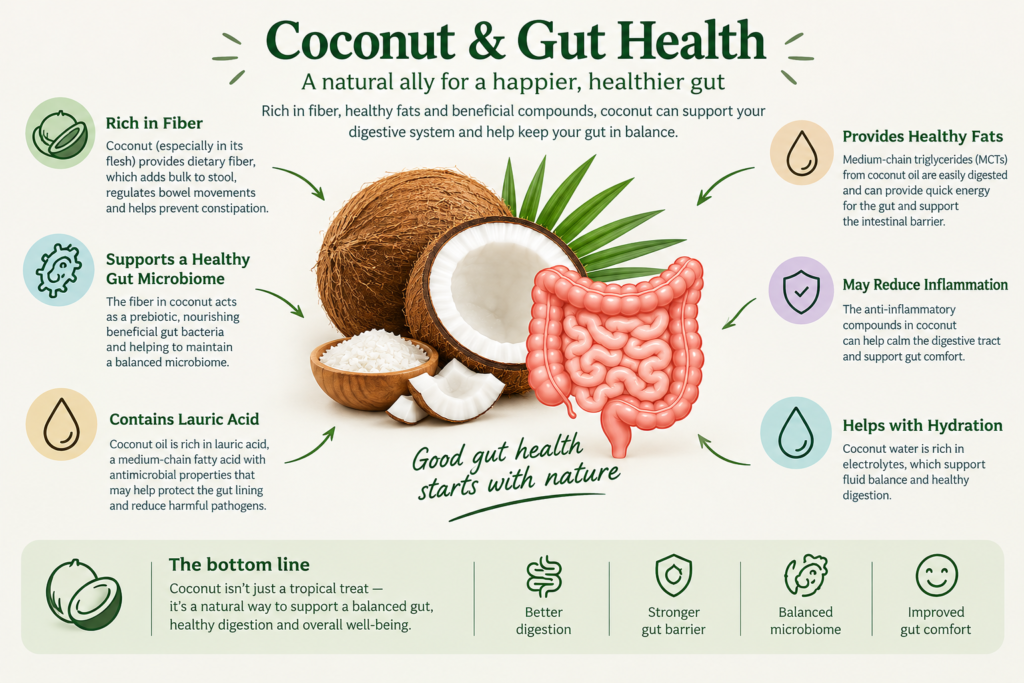
Coconut has gone from tropical staple to wellness favourite. Coconut oil in coffee, coconut flour in baking, coconut yoghurt on the breakfast table. But is coconut really good for your gut? The honest answer is: it depends on which part of the coconut you mean. The fibre-rich flesh and the oil behave very differently, and the evidence behind each is not the same.
Coconut fibre: fuel for your gut bacteria
The trillions of bacteria in your colon ferment dietary fibre into short-chain fatty acids (SCFAs) such as acetate, propionate and butyrate. These molecules nourish the cells lining the colon and help regulate the immune system [1]. A fibre-rich diet is also associated with a lower risk of inflammatory bowel disease, cardiovascular disease, colon cancer, obesity and diabetes [7]. If you want to explore another well-known prebiotic fibre, read our article on inulin and gut health.
Coconut flour, the pale by-product left after coconut is milled, is naturally high in fibre. In a 2025 laboratory study, researchers fermented coconut flour fibre with human faecal bacteria. It produced as much butyrate as inulin, though more slowly. It also favoured butyrate-producing bacteria such as Roseburia and Coprococcus and ended with greater microbial diversity (full abstract on PubMed) [2].
Another in-vitro study looked at polysaccharides from coconut testa, the thin brown skin of the kernel. They resisted simulated gastric juice (94-97% survived intact) and supported the growth of Lactobacillus. In one cultivar, the prebiotic activity score even exceeded that of inulin and fructo-oligosaccharides [3].
An important caveat: these are test-tube experiments. They show that coconut fibre can be a useful food for gut bacteria, not that eating it improves symptoms or health outcomes in people. Human trials are still needed.
Coconut oil: a more complicated story
Coconut oil contains no fibre, and it is very rich in saturated fat (about 83 g per 100 g). Regular consumption is known to raise total and LDL cholesterol [8].
What about the gut? In a nine-week, randomised, double-blind trial in overweight women following an energy-restricted diet, participants received soybean oil, extra virgin olive oil or coconut oil. Intestinal permeability increased after both olive oil and coconut oil [4]. What this means clinically is not yet clear, and the trial should not be over-interpreted, but it is a reminder that “natural” does not automatically mean “gut-protective”. To understand more about the barrier function of the gut, see our article on lectins and leaky gut.
Animal studies point in a similar direction of caution. In mice, diets enriched in coconut oil produced a different gut microbiota composition from soy-oil diets [5]. Another mouse study linked coconut oil to metabolic endotoxaemia and fatty liver, compared with soybean and olive oil, and found that an excess of any oil reduced microbial diversity [6]. Mice on high-fat diets are not the same as a spoonful of coconut oil in a curry, but the findings do not support the idea of coconut oil as a gut “superfood”.
How to enjoy coconut with your gut in mind
- Choose the fibre first. Unsweetened coconut flour or shredded coconut can be added to porridge, yoghurt, pancakes or baking.
- Start small. Increase fibre gradually and drink enough water to avoid bloating.
- Treat coconut oil as a cooking fat, not a supplement. Use it occasionally and in moderation, alongside other fats such as olive oil.
- Aim for variety. No single food shapes your microbiome. A diverse, plant-rich diet is the strongest lever you have.
When to be careful
If you have inflammatory bowel disease, irritable bowel syndrome, high cholesterol or another condition that requires a specific diet, talk to your doctor before making coconut a regular part of your routine. Individual responses to fibre vary a lot.
Key takeaways
- Coconut fibre shows promising prebiotic potential, but the evidence so far comes from laboratory studies.
- Coconut oil has no fibre, raises LDL cholesterol with regular use, and human and animal data do not show a clear gut benefit.
- Small amounts of coconut flour or shredded coconut are a reasonable way to add variety to a fibre-rich diet.
Want personalised advice on nutrition and digestive health? Get in touch to book a consultation.
References
[1] Mukhopadhya I, Louis P. Gut microbiota-derived short-chain fatty acids and their role in human health and disease. Nat Rev Microbiol. 2025. doi:10.1038/s41579-025-01183-w
[2] Arioglu-Tuncil S, et al. Coconut (Cocos nucifera L.) and carob (Ceratonia siliqua L.) flours dietary fibers differentially impact fecal microbiota composition and metabolic outputs in vitro. Food Sci Nutr. 2025. doi:10.1002/fsn3.4724. PMID 39867837.
[3] Exploring the prebiotic characteristics of crude polysaccharides from coconut testa flour: a comparative analysis of local cultivar. Heliyon. 2024;10:e30256. doi:10.1016/j.heliyon.2024.e30256. PMID 38707423.
[4] Effect of the ingestion of vegetable oils associated with energy-restricted normofat diet on intestinal microbiota and permeability in overweight women. Food Res Int. https://www.sciencedirect.com/science/article/abs/pii/S0963996920309765
[5] Differential effects of coconut versus soy oil on gut microbiota composition and predicted metabolic function in adult mice. BMC Genomics. 2018. doi:10.1186/s12864-018-5202-z
[6] Consumption of soybean or olive oil at recommended concentrations increased the intestinal microbiota diversity and insulin sensitivity and prevented fatty liver compared to the effects of coconut oil. J Nutr Biochem. https://www.sciencedirect.com/science/article/abs/pii/S0955286321001716
[7] Dietary gut microbial metabolites, short-chain fatty acids, and host metabolic regulation. Nutrients. 2015;7(4). doi:10.3390/nu7042839
[8] Postprandial responses to meals enriched with canola or coconut oil in men and women with a risk phenotype for cardiometabolic diseases: a randomized crossover trial. https://www.ncbi.nlm.nih.gov/pmc/articles/PMC12490190/