For decades, boron sat quietly on the sidelines of human nutrition — a trace element scientists associated more with glass manufacturing and agricultural fertilizer than with anything happening inside the human body. That reputation is changing fast. A wave of research published in 2025 and 2026 has started describing boron as something closer to a molecular translator between us and the trillions of bacteria living in our gut — a mineral that helps microbes talk to each other, and helps the intestinal wall stay properly sealed.
If you’ve already read our articles on magnesium and gut health or inulin and the gut microbiome, boron fits into the same emerging picture: gut health depends on more than fiber and probiotics — it depends on a supporting cast of minerals most people have never thought about.
What Exactly Is Boron?
Boron is a trace mineral naturally present in plant foods — almonds, raisins, prunes, avocados, and legumes are among the richest sources. Unlike calcium or iron, it was long considered “non-essential” for humans, mostly because no clear deficiency disease had ever been identified.
That framing is now considered outdated. A comprehensive 2025 review in Biomolecules concluded that boron’s biological role “has been reevaluated in light of emerging microbiome research,” distinguishing between boron that gets absorbed quickly into the bloodstream and a separate pool — called microbiota-accessible boron complexes — that travels intact all the way to the colon, where gut bacteria can actually use it [1].
How Boron Helps Bacteria Communicate
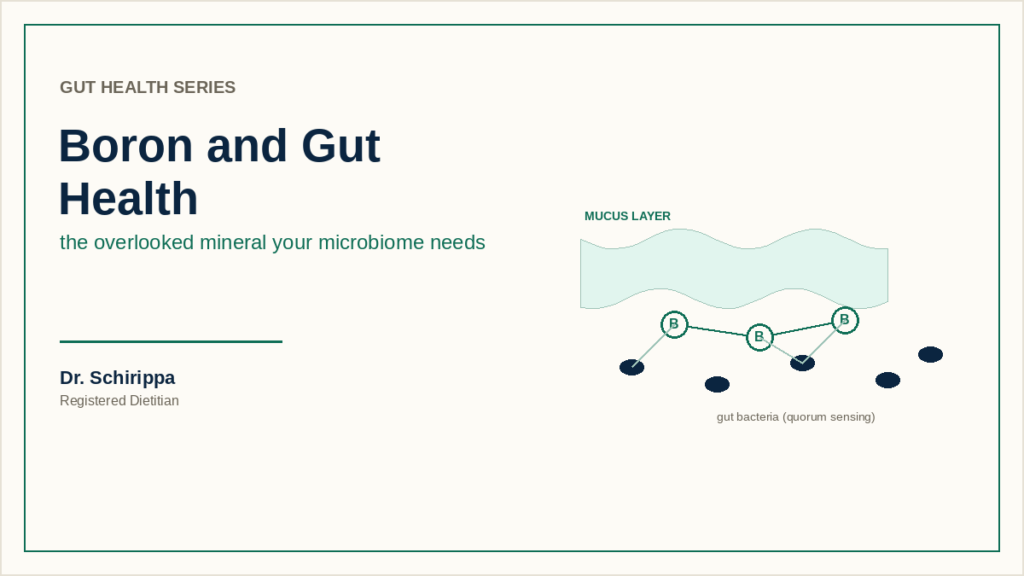
Gut bacteria don’t operate as isolated cells. They constantly exchange chemical signals to coordinate group behavior — a phenomenon researchers call quorum sensing, essentially bacteria “counting” each other through molecules released into their shared environment.
One of the most important quorum-sensing molecules, autoinducer-2, only becomes fully functional in its boron-bound form. Without adequate boron, researchers note, bacterial communication weakens — and a 2025 review linked this specific deficiency to intestinal dysbiosis [2]. A newer 2025 paper goes further, proposing the concept of “boron symbiotaxis” — describing boron as a stabilizing chemical bridge that actively shapes how the microbiome organizes itself around the gut lining [3].
Boron and the Intestinal Barrier
The second role boron appears to play is structural. The gut wall is protected by a mucus layer built largely from mucin, a gel-like substance that keeps bacteria at a safe distance from intestinal cells. Boron binds to specific sites within this mucin structure, contributing to its cohesion [4].
A 2026 paper in the journal Life pushed this idea further, describing boron as a “molecular architect” of the host-microbiome interface — capable of forming reversible chemical bonds with the sugar-rich molecules that dominate the mucus environment, thereby shaping the physical territory where bacteria and human cells interact [5]. When boron is scarce, this protective layer may thin, a condition often discussed under the term “leaky gut,” in which substances that should stay confined to the intestine begin crossing the weakened barrier more easily [4].
Food First
The research on boron is still young, and nobody is suggesting it as a stand-alone supplement strategy. The most sensible approach, consistent with the current evidence, is dietary: almonds, raisins, prunes, chickpeas, and leafy greens all provide meaningful amounts of boron as part of a varied diet — no extreme quantities required.
The Bigger Picture
Boron won’t headline any diet trend, and that’s rather the point. It’s one more example of how gut health rarely comes down to a single nutrient acting alone — it’s a network, where trace minerals most people have never heard of quietly support the ecosystem that digests our food, protects our intestinal wall, and — as we’ve explored elsewhere on this site — even helps regulate hunger and satiety.
References
1. Boron Bioavailability Revisited: From Plasma-Accessible Species to Microbiota-Accessible Complexes — Implications for Nutritional Essentiality. Biomolecules. 2025;15(12):1711. DOI: 10.3390/biom15121711
2. New Insights into Boron Essentiality in Humans and Animals. PMC9409115.
3. Boron symbiotaxis: a new concept in host–microbiome communication. Frontiers in Microbiology. 2025. DOI: 10.3389/fmicb.2025.1719918
4. New Insights into Boron Essentiality in Humans and Animals. PMC9409115 (mucin structure and intestinal permeability section).
5. Boron as a Molecular Architect of Host–Microbiome Symbiosis: Implications for Dysbiosis and Aging-Related Pathologies. Life. 2026;16(5):750. DOI: 10.3390/life16050750
This article is for informational purposes only and is not a substitute for professional medical advice.