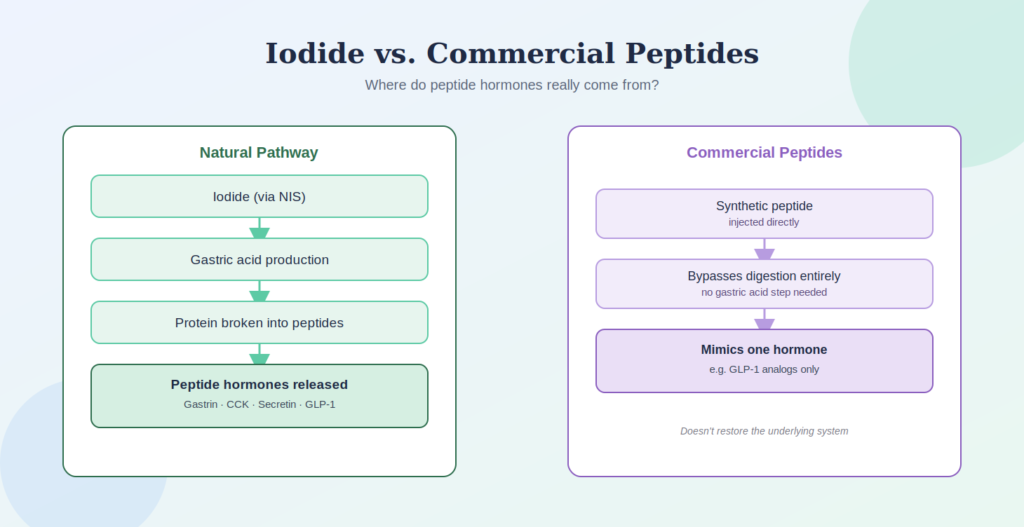
Most conversations about iodine begin and end with the thyroid. But iodine’s role in digestive physiology extends further upstream than most people realize — starting in the stomach itself, where it influences the acidic environment that makes protein digestion possible in the first place. Understanding this chain of events matters because the peptide fragments released during protein digestion aren’t just nutritional building blocks — they are direct signals that trigger the release of some of the body’s most important peptide hormones.
Why Stomach Acid Is the Starting Point
Gastric acid, produced by parietal cells via the H+/K+-ATPase proton pump, does far more than create an inhospitable environment for pathogens. Gastric acid aids digestion by creating the optimal pH for pepsin and gastric lipase, and it also stimulates pancreatic bicarbonate secretion. Without sufficiently low gastric pH, pepsinogen cannot be converted into its active form, pepsin — and without active pepsin, dietary protein cannot be broken down into the peptides and amino acids the rest of the digestive cascade depends on.
This acid production facilitates the digestion of protein as well as the absorption of iron, calcium, vitamin B12, and thyroxine itself, and also helps prevent bacterial overgrowth and enteric infection. This creates an important feedback relationship: adequate thyroid hormone production depends on adequate iodine, and adequate gastric acid — which depends partly on healthy thyroid-related cellular function — is in turn necessary to absorb the very nutrients, including iodine itself, that support thyroid function.
The Iodine-Acid Connection
Iodine’s relationship with the stomach isn’t limited to being absorbed there. The sodium-iodide symporter (NIS) actively transports iodide from the bloodstream into gastric mucosal cells, from which it is then secreted into the gastric juice itself — a process largely mirrored in the salivary glands. NIS is now understood to be a central molecule in iodine metabolism throughout the body: mediating dietary iodine absorption in the small intestine, iodine uptake in the thyroid, and iodine accumulation in saliva and gastric juice, from which it is reabsorbed and recycled by the digestive system.
Clinically, the more established side of this relationship runs through thyroid function broadly: hypothyroidism is a documented cause of reduced gastric acid output, or hypochlorhydria, since adequate thyroid hormone supports the normal function of parietal cells. Correcting an underlying iodine deficiency — where that is the root cause of low thyroid hormone — can therefore be part of restoring healthy acid production, which in turn restores the conditions protein digestion depends on. This is a physiologically coherent pathway, though it’s worth being precise that iodine’s effect here is largely indirect, mediated through thyroid hormone status, rather than iodine acting as a direct acid secretagogue in the way histamine or gastrin do.
From Digested Protein to Peptide Hormones
Once gastric acid has activated pepsin and begun breaking dietary protein into smaller peptides and free amino acids, those fragments become active signaling molecules in their own right. The stimulatory effects of dietary proteins, peptides, and amino acids on further digestive processes are well established — protein-rich foods are among the most powerful stimulants of digestive hormone secretion, in proportion to their protein content. This is where protein digestion connects directly to peptide hormone synthesis and release. Several named hormones are central to this cascade:
Gastrin. Gastrin is a peptide hormone released primarily by G cells in the gastric antrum in response to the arrival of peptides and amino acids from digested protein, along with gastric distension. Its job is to further enhance gastric acid secretion, stimulate gastric motility, and support the growth of the gastric mucosa — reinforcing the very digestive process that produced the peptides that triggered its release in the first place.
Cholecystokinin (CCK). Released by I cells in the duodenum in direct response to peptides, amino acids, and fats entering the small intestine, CCK stimulates gallbladder contraction and bile release, triggers pancreatic enzyme secretion for further protein and fat breakdown, and acts on the brain as a potent short-term satiety signal — one of the reasons adequate protein digestion is closely tied to appetite regulation.
Secretin. Secretin is released from duodenal cells in response to the arrival of gastric acid and the products of fat and protein digestion in the small intestine, and it works to decrease further acid secretion by inhibiting gastrin release, while also stimulating pancreatic secretion of water and bicarbonate. This makes secretin a key regulatory brake in the system, preventing gastric acid output from overshooting once digestion is well underway.
GLP-1 and PYY. Further downstream, in the distal small intestine and colon, amino acids and peptides — alongside carbohydrates and fats — help trigger the release of glucagon-like peptide-1 (GLP-1) and peptide YY (PYY) from specialized L-cells. These two hormones slow gastric emptying, enhance insulin secretion in response to meals, and produce a longer-lasting sense of fullness. This is the same hormonal family targeted by modern GLP-1 receptor agonist medications — except here, it is the body’s own digestive signaling, not a pharmaceutical, doing the work.
Together, this cascade illustrates why insufficient stomach acid doesn’t just cause bloating or reflux symptoms — it can blunt the entire downstream hormonal signaling system responsible for satiety, blood sugar regulation, and digestive coordination.
Within our gut health protocols, restoring healthy acid production is consistently one of the first steps addressed, precisely because so much of this hormonal cascade depends on it functioning properly from the very start.
Inulin and the Second Pathway to GLP-1
While protein digestion drives one route to GLP-1 release, a separate and well-documented pathway runs through the colon — and this is where inulin, a fermentable prebiotic fiber, becomes relevant.
Endogenous GLP-1 is released by intestinal L-cells in response to nutrient sensing, bile acid signaling, and microbial metabolites, among which short-chain fatty acids (SCFAs) — including acetate, propionate, and butyrate — are produced through the fermentation of dietary fibers like inulin in the colon. These SCFAs activate free fatty acid receptors FFAR2 and FFAR3 on intestinal L-cells, directly stimulating GLP-1 secretion, with propionate acting as the most potent activator of these receptors.
The clinical evidence for this pathway is meaningful, though not entirely uniform. In one frequently cited human trial, 16 grams of inulin consumed daily over two weeks increased breath hydrogen excretion along with plasma GLP-1 and PYY concentrations, while lowering both hunger ratings and postprandial blood glucose responses after a standardized meal. Similar effects have been demonstrated in the context of bariatric surgery, where a related formulation of oligofructose-enriched inulin was tested directly against a control carbohydrate load in gastric bypass patients specifically to assess its impact on gut hormone release and appetite.
It’s worth noting that not every study finds this effect with the same consistency — at least one trial found that acute, single-dose increases in colonic SCFAs from inulin did not measurably raise GLP-1 or PYY in either lean or overweight participants, though it did appear to reduce the hunger hormone ghrelin. This suggests the appetite-regulating benefits of inulin may depend more on sustained, regular intake — allowing the gut microbiota to adapt and SCFA production to stabilize — rather than a single dose producing an immediate hormonal spike.
Bringing the Two Pathways Together
What makes this picture clinically useful is that iodine-supported gastric acid production and inulin-driven SCFA fermentation are not competing mechanisms — they act on different segments of the digestive tract but converge on the same hormonal outcome: a more robust GLP-1 response, alongside healthier gastrin, CCK, and secretin signaling throughout the process. For patients working through obesity or metabolic recovery protocols where appetite regulation and blood sugar stability are central goals, supporting both ends of this system — adequate stomach acid upstream, adequate fermentable fiber downstream — targets the body’s own hormonal machinery rather than replacing it.
Bibliography
Overview of Acid Secretion. MSD Manual Professional Edition. Updated January 2025. Stomach Acid Secretion. ScienceDirect Topics, Elsevier. Nakamura Y, et al. Physiology, Gastrin. StatPearls, NCBI Bookshelf, National Library of Medicine. Nutritional Regulation of Gastric Secretion, Digestion and Emptying. Nutrition Research Reviews. Cambridge University Press. NASPGHAN Physiology Series: Gastric Secretions. Nicola JP, et al. Dietary I⁻ Absorption: Expression and Regulation of the Na⁺/I⁻ Symporter in the Intestine. ScienceDirect / Vitamins and Hormones. 2015. Nicola JP, et al. The Na⁺/I⁻ Symporter Mediates Active Iodide Uptake in the Intestine. PMC, National Library of Medicine. Iodide. ScienceDirect Topics, Elsevier. Dietary Fibers to Boost Endogenous GLP-1 Secretion and Satiety: A Scoping Review. Frontiers in Endocrinology. 2026. doi:10.3389/fendo.2026.1880500 Steinert RE, Mueller M, Serra M, et al. Effect of inulin on breath hydrogen, postprandial glycemia, gut hormone release, and appetite perception in RYGB patients: a prospective, randomized, cross-over pilot study. Nutrition & Diabetes. 2024. doi:10.1038/s41387-024-00267-5 Chambers ES, et al. Acute increases in serum colonic short-chain fatty acids elicited by inulin do not increase GLP-1 or PYY responses but may reduce ghrelin in lean and overweight humans. PubMed. Trompette A, et al. From Dietary Fiber to Host Physiology: Short-Chain Fatty Acids as Key Bacterial Metabolites. Cell. 2016. Psichas A, Sleeth ML, Murphy KG, et al. The short chain fatty acid propionate stimulates GLP-1 and PYY secretion via free fatty acid receptor 2 in rodents. International Journal of Obesity. 2014. doi:10.1038/ijo.2014.153