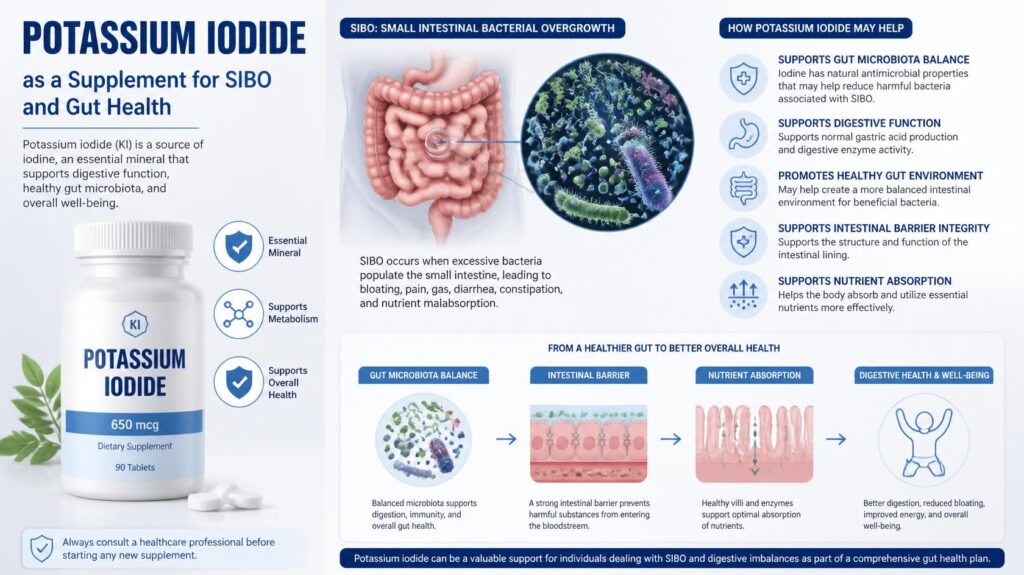
For years, iodine has been treated as a simple story: not enough of it, and your thyroid slows down. But a growing body of research is revealing something more complicated — the mineral’s fate in your body depends heavily on what’s happening in your gut, and specifically on whether small intestinal bacterial overgrowth (SIBO) is present. Understanding this connection matters for anyone dealing with unexplained thyroid symptoms, bloating, or a stalled response to iodine supplementation.
The Gut-Thyroid Axis: A Two-Way Street
Researchers now describe a bidirectional relationship they call the “gut-thyroid axis.” SIBO has been associated with hypothyroid patients partly because reduced thyroid function can slow digestive transit, creating conditions where bacteria overgrow in the small intestine. But the relationship runs both ways: low thyroid function itself appears to promote SIBO through slowed gut motility, while the resulting bacterial overgrowth and inflammation weaken the intestinal barrier, and the microbiome plays a central role in absorbing thyroid hormone replacement medication along with critical minerals like iron, selenium, iodine, and zinc. Zenwise + 2
This creates what researchers describe as a self-reinforcing loop. A weakened thyroid slows the gut down, the slowed gut allows bacteria to overgrow, and that overgrowth further impairs the absorption of the very nutrients the thyroid needs to function. Once this cycle starts, addressing only one side of it — supplementing iodine without addressing the gut, for example — often produces disappointing results. nih
Where Iodine Absorption Actually Happens
Understanding why SIBO matters for iodine requires knowing where in the gut iodine is absorbed in the first place. The vast majority of dietary iodine is absorbed very early in the digestive process — in the stomach and the duodenum, the first segment of the small intestine — before being shuttled into the bloodstream via a transport protein called the sodium-iodide symporter, or NIS. This is actually good news for the trillions of beneficial bacteria living further down in the colon, since most iodine never reaches them in significant concentration under normal circumstances.
The problem is that SIBO occurs precisely in the segment where iodine absorption is supposed to happen cleanly. The small bowel normally hosts relatively few bacteria compared to the colon — under 10,000 organisms per milliliter versus over a billion in the large intestine — which is exactly why an overgrowth in that zone disrupts normal digestive physiology so significantly. When bacterial populations expand abnormally in the duodenum and jejunum, they interfere directly with the surface where iodine, along with several of its essential cofactors, would normally cross into the bloodstream.
The Molecular Mechanism: How Bacteria Disrupt Iodine Uptake
The clearest mechanistic explanation involves the NIS transport protein itself. Lipopolysaccharides, structural components found in the outer membrane of gram-negative bacteria that proliferate during SIBO, have been shown to alter the expression of the sodium-iodide symporter, directly disrupting the thyroid’s ability to take up iodine. This gives SIBO a direct molecular route to undermine iodine status, independent of dietary intake.
The gut microbiome also governs iodine’s essential cofactors. Beneficial gut bacteria influence the bioavailability of both iodine and selenium — a mineral required for the enzymes that activate thyroid hormone — and this relationship appears reciprocal, since inflammatory bowel conditions that reduce microbial diversity are also linked to poor iodine absorption. Without adequate selenium, even iodine that is successfully absorbed may not be efficiently converted into usable thyroid hormone.
Short-chain fatty acids (SCFAs), the beneficial metabolites produced by a healthy microbiome, add another layer. Butyrate, one of the primary SCFAs produced by gut bacteria, has been shown to influence NIS activity by affecting histone deacetylase function, which in turn can upregulate iodine-transport protein expression. A dysbiotic gut — one dominated by SIBO rather than diverse, butyrate-producing bacteria — is therefore doubly disadvantaged: more inflammatory LPS suppressing NIS, and less butyrate available to support it.
Not All Iodine Behaves the Same Way
This is where the specific chemical form of iodine becomes clinically relevant. Most supplements use potassium iodide or sodium iodide, salt forms of the mineral that are generally gentler on digestive tissue compared to elemental iodine or high-dose tincture formulations. Laboratory research examining oxidative stress supports this distinction directly: a study comparing potassium iodide and potassium iodate on thyroid tissue found that potassium iodide, unlike potassium iodate, offered protection against oxidative damage to membrane lipids under experimental conditions replicating the Fenton reaction — the same reaction pathway involved in normal thyroid hormone synthesis. This is one reason potassium iodide, rather than other iodine salts, tends to be the preferred form in clinical supplementation protocols.
That said, dose and gut context both matter. While inadequate iodine can itself harm gut health by slowing digestion and encouraging the kind of bacterial overgrowth associated with SIBO, higher-dose supplementation shifts the picture — larger amounts are more likely to travel past the duodenum into segments of the gut where they can interact directly with resident bacterial populations, for better or worse depending on existing dysbiosis.
Excess intake carries its own separate risk profile. Research using both human patients and animal models found that excessive iodine intake alters gut microbiota composition and reduces butyric acid production, disrupting the balance between regulatory and inflammatory immune cells in ways linked to autoimmune thyroid conditions like Hashimoto’s thyroiditis. This underscores why iodine supplementation, including with potassium iodide, is not a “more is better” mineral — especially in patients with autoimmune thyroid involvement, where our clinical protocols for autoimmune nutrition place particular emphasis on individualized dosing rather than blanket supplementation.
Why Testing and Sequencing Matter
Although several studies confirm an association between hypothyroidism and SIBO, researchers note that some studies suggest hypothyroidism itself reduces gut motility, increasing SIBO risk, while a reciprocal relationship — in which altered gut bacteria populations influence thyroid status — has also been actively explored. In practical terms, this means clinicians often cannot assume which condition came first, and treating iodine deficiency in isolation, without evaluating gut function, risks missing the actual driver of the problem.
A SIBO test, along with screening for H. pylori and other infectious markers, is increasingly considered relevant given their documented connections to thyroid disorders and nutrient absorption issues. For patients who have supplemented with iodine — including well-absorbed forms like potassium iodide — without symptom improvement, this is often the missing piece: the gut environment itself may be preventing effective uptake regardless of the form or dose used.
This is consistent with what we see in our clinical approach to gut health: mineral status, digestive symptoms, and thyroid function need to be evaluated together, not as separate issues addressed with isolated supplements.
The Clinical Takeaway
The relationship between potassium iodide, SIBO, and gut health isn’t a simple cause-and-effect story — it’s a feedback loop involving bacterial overgrowth, symporter proteins, cofactor minerals, and inflammatory signaling molecules, all influencing one another simultaneously. For patients with persistent thyroid symptoms despite adequate iodine intake, or digestive symptoms alongside thyroid dysfunction, the evidence increasingly points toward evaluating gut health — and specifically ruling out SIBO — as a necessary step, rather than defaulting to higher iodine doses alone.
Bibliography
- Jiang W, Lu G, Gao D, Lv Z, Li D. The relationships between the gut microbiota and its metabolites with thyroid diseases. Front Endocrinol (Lausanne). 2022;13:943408. doi:10.3389/fendo.2022.943408
- Silva IB, Puig-Domingo M. The impact of thyroid disorders on the gut microbiome: emerging mechanisms and clinical relevance. Arch Endocrinol Metab. 2025. doi:10.20945/2359-4292-2025-0075
- Gong B, Meng F, Wang X, Han Y, Yang W, Wang C, Shan Z. Effects of iodine intake on gut microbiota and gut metabolites in Hashimoto thyroiditis-diseased humans and mice. Commun Biol. 2024;7. doi:10.1038/s42003-024-05813-6
- Milczarek M, Stepniak J, Lewinski A, Karbownik-Lewinska M. Potassium iodide, but not potassium iodate, as a potential protective agent against oxidative damage to membrane lipids in porcine thyroid. Thyroid Res. 2013;6:10. doi:10.1186/1756-6614-6-10
- Waugh DT. Fluoride Exposure Induces Inhibition of Sodium/Iodide Symporter (NIS) Contributing to Impaired Iodine Absorption and Iodine Deficiency: Molecular Mechanisms of Inhibition and Implications for Public Health. Int J Environ Res Public Health. 2019;16(6):1086. doi:10.3390/ijerph16061086
- Relationship Between Hypothyroidism, Risk of Small Intestinal Bacterial Overgrowth, and Duodenal Microbiome Alterations. J Clin Endocrinol Metab. Oxford Academic, 2025.
- Microbiota and Thyroid Interaction in Health and Disease. ScienceDirect, 2019.
- Microbiota dysbiosis impact on the metabolism of T3 and T4 hormones and its association with thyroid cancer. PMC, National Library of Medicine.