The Dr. Schirippa Method — The book to break free from Binge Eating Disorder
Binge eating has become an epidemic of the modern Western world. An epidemic of diabetes, heart attacks, strokes, Alzheimer’s, Parkinson’s, autoimmune disorders, and cardiovascular events. The number of people who suffer from this disorder is greater than the number of people who suffer from anorexia and bulimia combined. And unfortunately, new diagnoses are being made every single day.
There are now millions upon millions of people who no longer have any willpower in front of certain foods, whose self-control collapses the moment they’re faced with pizza, sweets, chocolate, cheese, cookies, chips, and the like. And as if that weren’t enough, the food industry pours enormous capital into research aimed specifically at making its processed, refined products stimulate certain areas of the brain to trigger a mechanism of addiction. I won’t spend time listing everything that happens in the brain, because nutrition professionals already know it all too well. But it’s worth saying that even people who don’t eat refined foods often suffer from this same disorder. So what’s really going on?
Why Willpower Isn’t the Problem
Let’s start by calling this disorder what it actually is: an addiction. Because that’s exactly what it is — certain foods act on the brain just like a drug. Your willpower is powerless once you’re caught in the grip of obsession over these foods, and eventually they drag you into binge patterns you have no control over. In a strange way, the person with bulimia is almost fortunate compared to you: at least they can purge, or compensate through exercise or fasting. You can’t. You just eat. And you get sick.
It’s useless — I know it’s useless — to tell you that walking down the candy aisle at the supermarket, just looking at the packaging, triggers an obsession to eat that product. Or the ice cream aisle. Or the cheese aisle. And it doesn’t matter that you’ll feel awful afterward — the food will always be stronger than you.
I want to be honest with you: if you had ever been able to see a diet through to the end, you wouldn’t be reading these words right now. Or maybe you did see one through, only to go right back to eating without any control. “Tomorrow I’ll stop.” How many times have you said that?
What the DSM-5 Says About Binge Eating
The DSM-5, the standard psychiatric manual, classifies this disorder as a genuine psychiatric condition, and the most common treatment approach today is multidisciplinary, involving dietitians, psychologists, psychiatrists, and sometimes medication.
The Real Difference Between You and Everyone Else
But what happens to you when you walk past a pizzeria, a bakery, the cheese counter at the supermarket, or when you spot a jar of mayonnaise or a bag of chips — who could ever truly understand that? Who could ever understand what gets triggered in your mind the moment that irresistible impulse hits? The truth is, you will never make peace with food — because if you could have, you already would have.
So what’s the defining trait, more than anything else, of people who struggle with binge eating? After years of clinical practice, I can answer that: it’s a heightened tolerance for discomfort and pain following the excessive intake of food. A person without a binge eating disorder stops eating once they’re full, sensing that eating more would make them feel physically unwell. But for someone with a food addiction, none of that matters — not the stomachache, the heartburn, the intestinal pain, the fatigue, the blood sugar spikes, the heart palpitations, or any of the other health problems that follow a binge. Food makes you forget everything — even your health. And let’s not even get into the emotional toll of not feeling comfortable in your own body, or the strain it puts on relationships and intimacy.
What Science Gets Wrong About Binge Eating
But what does science say about all this? What’s the real trigger behind the problem? Science tells us that a dopamine-driven addiction mechanism takes hold whenever we eat something we enjoy or find gratifying. Dopamine rises in certain areas of the brain, and when it crashes just as suddenly after the binge, a relentless search for gratification kicks in, pushing you to repeat the same pattern over and over. In short, you end up chasing the dopamine spike, again and again.
Is that really the whole explanation, though? Would that mean people with binge eating disorder simply break down dopamine too quickly, leaving their brain’s reward centers running short almost instantly? That millions upon millions of people all happen to share some malfunction in how long dopamine lingers in the synapses, or how quickly it’s reabsorbed? And yet, if we compare that explanation against the real numbers behind this epidemic, we find that it’s fairly shaky — it doesn’t fully match what we actually observe, especially across Western countries.
This Book Is Written For You
This book is written for those of you who struggle with binge eating, who eat without being able to stop or regulate yourselves, who watch your own willpower collapse in front of certain foods without being able to resist.
Do you really have no willpower? I don’t believe that for a second. The real problem is different: you don’t lack willpower across the board — only when it comes to food. Everywhere else in your life, you have plenty of it. I’m speaking to you, the people who have spent years fighting against something that has you in chains. Why is it that you don’t binge on meat, or beans, or zucchini, or broccoli — but instead binge on pizza, ice cream, bread and cheese, milk and cookies, cream-filled pastries, chocolate, cake, chips — on everything, in other words, that seems to give you pleasure but is actually taking it away, stealing your life out from under you?
Why Trust Dr. Schirippa
If you’re ready to stop stuffing yourself, to stop fighting a losing battle against food with exhausting diets you can never stick to — because food is always stronger than you — then stay with me until the end of this book. It isn’t long. And you’ll find that whatever you spent on it will pay you back many times over, sparing you from all the future suffering that comes with binge eating.
But who am I to say all this? I’m not a coach. I’m not a motivational speaker or a psychologist, and I’m not here to dig into what’s going on in your soul — because the problem was never in your soul to begin with. I won’t be giving you mental tricks or willpower exercises to avoid food, because I already know they don’t work. I’m a dietitian, and over years of clinical practice, I’ve resolved cases just like yours. The truth — the real root cause of all this — is far simpler than you could ever imagine. Follow me through this book, and I promise you’ll find the right distance from food again. You’ll find freedom, and without a fight. But first, you need to understand a little biology and a little physiology — bear with me. It matters, because you need to understand what’s actually happening inside you, at the level of your own biochemistry. I’ll keep it simple; anyone can follow it. The practical steps for freeing yourself from food addiction are at the very end of the book, in the last chapter — so don’t worry if, as you read, you don’t find anything immediately actionable. Everything in its own time. First, it’s important that you understand how you actually work, because I want it to be completely clear why certain supplements can genuinely solve your problem. And don’t worry — the money you spent on this book is the best investment you will ever make in your health. Come on. Follow me.
Dr. Schirippa
Two Days in Elena’s Life
A story that isn’t true, but is as true as few others — built from the experience of many real people, for anyone who recognizes themselves in these pages
The person you’re about to meet doesn’t exist. But everything that happens to her in these pages has happened, in one form or another, to hundreds of patients I’ve worked with over the years. I chose to tell it as a story, rather than as a list of symptoms, because some things are easier to understand when we live them through someone else’s eyes — even if, this time, that someone is made of paper. If you recognize yourself in even a few of these moments, know that you’re not alone, and that the book following this story is written just for you.
Friday, 8:14 a.m. — The Bakery Window
Elena leaves the house ten minutes early, for once. She slept well, and she has an orderly day planned out in her head: work, skip the gym but that’s fine, a light dinner tonight, really, this time she’ll manage it. Then she turns the corner and the usual bakery has just rolled up its shutters. The glass is still fogged from the heat of the ovens, and behind that glass are the cream-filled pastries, the ones with powdered sugar that melts the moment you touch it, lined up in a neat row like little soldiers.
She doesn’t decide to stop. She’s already inside before she even realizes she’s crossed the street. “Two, please,” she says, and her voice comes out almost foreign to her, as if it weren’t really her speaking. She eats them standing up, outside the shop, quickly, with a gesture she knows all too well: glancing around before the first bite, to make sure no one’s watching.
Friday, 1:02 p.m. — The Sandwich Shop Below the Office
She’d promised herself a salad for lunch. But her deskmate suggests the new sandwich place, the one with the “triple cheese” burger spelled out in red decal letters on the door, and Elena already feels defeated before she’s even ordered. She orders the salad anyway. Then, while they wait, she looks up at the menu board behind the counter, at the glossy photo of the burger dripping with melted cheese, and something inside her tightens, switches on.
She changes her order in a low voice, almost embarrassed with herself. The triple cheese, fries included, and she adds mayonnaise when the girl at the register offers it, even though she hadn’t asked for it. She eats it quickly, without really tasting it, with that familiar feeling of already being somewhere else in her head, already on the next bite before she’s finished the one in her mouth.
Friday, 6:47 p.m. — The Supermarket, Dairy Aisle
She only needed to buy milk for tomorrow’s breakfast. But the dairy aisle in that supermarket is laid out — she knows it, she’s read it somewhere — specifically to make you slow down: creamy cheeses, Greek yogurt already swirled with honey, balls of buffalo mozzarella that seem to breathe under their plastic wrap. Elena finds herself buying before she’s even noticed: two tubs of cream cheese, a container of whole-milk yogurt, a box of milk cookies that wasn’t on her list.
In the parking lot, before she’s even started the car, she opens the box of cookies and eats six of them, one after another, staring straight ahead through the windshield, as if staring into empty space could somehow make her invisible to herself.
Friday, 10:30 p.m. — After Sunset, the Dark Kitchen
It’s here, in the evening, after sunset, that Elena’s day hits its lowest — and most familiar — point. She had a normal dinner, a piece of meat and salad, nothing excessive. But an hour later, alone at home, with the TV on more for background noise than any real interest, she finds herself standing in front of the open refrigerator, its interior light the only light on in the whole kitchen.
She isn’t hungry. She knows that for certain, in some clear-eyed corner of her mind that watches all of this as if from the outside. But her hands move anyway: the bread, the cheese she’d bought that afternoon, a spoonful of Nutella taken straight from the jar because washing one more dish, right now, feels like an insurmountable obstacle. She eats standing up, in the dark, the refrigerator door swinging shut on its own after a few minutes and leaving her in total darkness while she keeps chewing.
When it happens, in these moments, Elena isn’t thinking about anything at all. It’s as if some part of her were pushing her on purpose, to keep eating, ignoring every signal telling her to stop. Only afterward, once she’s put away what’s left — hiding the jar of Nutella at the back of the pantry, as if anyone would ever check — does the rest arrive: the shame, heavy and familiar as an old blanket, and the thought, always the same, always at the same hour: “Tomorrow I’ll really start over.”
Saturday, 11:15 a.m. — The Ice Cream Shop Window
On Saturday morning, Elena walks past the ice cream shop downtown with the firm intention of not stopping. She’s even crossed the street on purpose, putting a row of parked cars between herself and the window. But the window is still visible from there: the tubs of pistachio and hazelnut arranged in rippling waves, the hand-lettered sign reading “Artisanal,” two kids walking out with cones already dripping.
She crosses back. She doesn’t decide to — later, looking back on it, she won’t be able to recall the exact moment she made up her mind, because there was never really a decision made. There was only an impulse that simply won, the way it almost always does. She walks out with a large cup, pistachio and stracciatella, and finishes it before reaching the next corner, walking quickly, eyes down.
Saturday, 8:40 p.m. — The Party She Didn’t Go To
There was a party tonight. A coworker turning thirty, and Elena had promised she’d stop by. She’d even bought a new dress, three weeks ago, convinced that by now she’d be “more in shape.” The dress is still in the shop bag, never tried on a second time since the fitting room, because that first time, in front of the three-way mirror, what she saw was enough to make her decide she’d never wear it.
She sends a text with an excuse — a headache, not true — and stays home. It isn’t the first party she’s skipped this year, and it isn’t the first date with a man she met online who canceled at the last minute, with some excuse, the night before. She knows it isn’t just about the dress. She knows it’s harder to open up to someone, to let someone see her, when she herself struggles to look in the mirror. So the party turns into another evening in the kitchen, and the kitchen turns, once again, into bread with melted cheese microwaved and eaten straight from the plastic container she heated it in, because tonight too, washing a dish feels like it’s asking for a strength she simply doesn’t have.
Sunday, 9:00 a.m. — The Resolution, Once Again
Sunday morning Elena weighs herself. The number on the scale doesn’t surprise her — she already knew it, in a way she always knows — but it weighs on her all the same, every time as if it were the first. She makes a mental list, the same one she makes every Sunday: no bread for a week, no sweets, an hour at the gym three times, the diet she found online and has already downloaded four different times over the past two months, always abandoned by Wednesday.
It isn’t laziness, even though that’s what she tells herself when she’s being hardest on herself. And it isn’t, either, as a coworker once told her lightly, “a lack of willpower” — Elena finished a demanding master’s degree while working full-time, cared for a sick parent for two years without ever missing a shift, has a determination that no one would question in any other part of her life. And yet, standing in front of a bakery window, that same determination vanishes, as if it had never existed.
What Elena Doesn’t Know Yet
Elena doesn’t know that her weight, having climbed by a great many pounds over the past five years, is slowly pushing her toward a real risk of type 2 diabetes, of high blood pressure, of a liver that’s already beginning to quietly build up excess fat. She doesn’t know that her joints, every single day, are carrying a load they were never built to bear, and that in a few years they may start making her pay for it. She doesn’t know that the risk of certain cancers, of cardiovascular problems, rises in a measurable way with every pound that accumulates this way, evening after evening, storefront window after storefront window.
She doesn’t know it because no one has ever explained it to her clearly, or because when someone did try to tell her, all she heard was judgment, not information — and she closed herself off even more. Above all, she doesn’t know that what happens to her every evening after sunset isn’t a weakness of character, but something precise, something biological, something treatable — something with a name, with well-understood mechanisms, and above all, with a real way out, different from yet another diet downloaded from the internet.
Not sure if what you just read applies to you? Take the Food Addiction Questionnaire to find out.
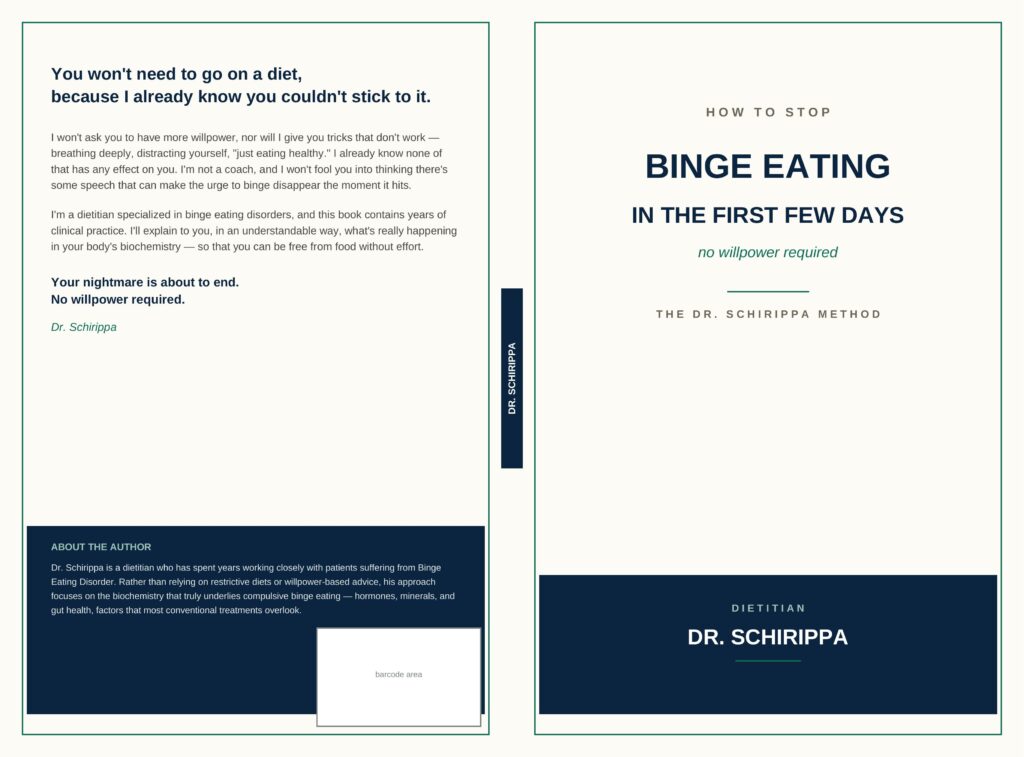
If you recognized even a single moment of your own week in these pages, this book was written exactly for you. Get your copy today and start the Dr. Schirippa Method.
Still have questions? Ask Dr. Schirippa directly.